

Introduction
Ask an audit partner what slows an engagement and you may hear about staffing, scope changes, and the challenges of training new employees. Ask the people doing the work and you will hear something different. They will say that their engagements are inefficient because they are waiting on a client, or they are fixing something a client sent.
Incomplete, inaccurate, and delayed client responses have become the biggest bottleneck in accounting. Efficient engagements can only happen when they are based on high-quality client information. And with the rise of AI in accounting, this bottleneck will only become more acute.
Firms have lived with this problem for so long that most treat it as a normal and unavoidable part of the job.
Suralink’s 2026 CPA Market Study, which surveyed practitioners at hundreds of accounting firms across North America, Europe, and APAC, helps firms understand the root cause of this bottleneck, and how, with the right technology partners, they can address it.
It’s important to note that this market study was conducted by an independent market research firm, and the vast majority of respondents were from firms that do not use Suralink. As you’ll see later in this report, firms that use Suralink significantly outperform their peers in addressing these critical challenges.
Accounting’s Biggest Bottleneck: The Client Readiness Gap
For years, Suralink has been independently researching and working with firms to address the Client Readiness Gap: the gap between what a firm needs from a client and what the client delivers. We originally introduced the concept in our report, Inside the Client Experience. Across the accounting industry, roughly 30% of engagements run into significant challenges.[1] When we ask practitioners about the root causes of problems on audit engagements, inaccurate or incomplete client data ranked #1[2].
In our study we found that firms consistently highlight that requesting and assessing client documents are the two steps of an engagement that they struggle with most.[3] These are the steps where the Client Readiness Gap manifests itself.
Why does the Client Readiness Gap have such a significant impact on engagements?
Accounting firms are dependent on their clients to provide them with complete and accurate data in a timely manner. Without this, engagements are doomed to experience challenges that have become far too familiar across the industry, including: Missed deadlines and/or last-minute scrambles, degraded profitability, frustrated firm and client team members.
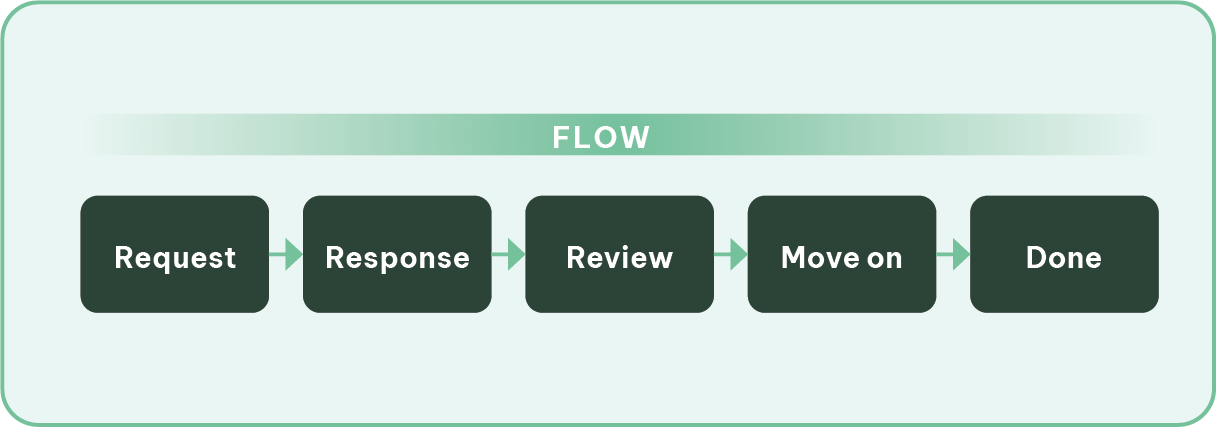
An ideal engagement looks like a highly-efficient lean manufacturing process. The firm requests a piece of information. The client immediately responds to that request with complete and accurate answers. The firm then immediately reviews that response, confirms its accuracy and completeness, and then moves on with their procedures. No rework is needed.
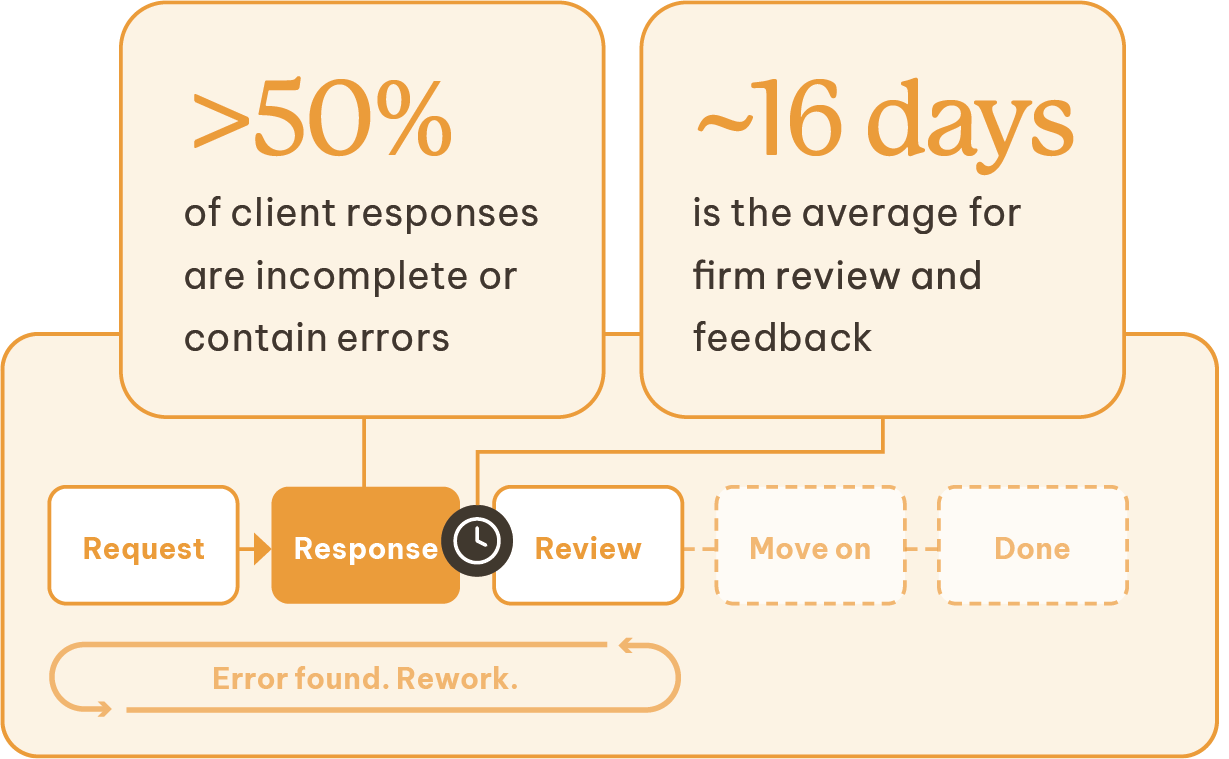
Experienced accounting professionals know that the process never works this way. The ideal engagement gives way to the real engagement, because of two prevalent process gaps that consistently violate core lean principles. Each of the two gaps is a significant and measurable drag on engagement efficiency.
Ideal engagement
Real engagement
Gap #1: Incomplete or inaccurate responses
Five common reasons client responses come back wrong:
- Wrong period: The data covers the wrong period, or only part of the period the firm needs.
- Detail does not match: Transaction detail does not match what the firm expects, and no additional detail explains the variance.
- Evidence falls short: The evidence does not meet the firm’s requirements.
- Partial answer: The data provided is correct but answers only part of the request, and the client is still gathering the remaining pieces that are needed.
- Thin request: The firm’s request did not give the client enough detail to know what the firm wants.1
Gap #2: Errors surface late
Three primary reasons errors surface late:
- Competing engagements: Team members work on several engagements at once and cannot review submissions right away.
- Batched reviews: They batch their work and wait until the client appears to have answered most requests.
- Hidden until procedures begin: The team member’s initial review suggests the response is accurate, and the errors aren’t discovered until detailed procedures and analysis begin.1
Together, these two gaps compound upon each other
Roughly 55% of client responses need correction. Firms take more than two weeks to review those client responses, find what needs to be corrected, and provide the needed feedback. This process repeats itself across dozens or hundreds of requests in an engagement. The result is the missed deadlines, last-minute scrambles, and frustrated teams that audit professionals know far too well. And this immediately shows up in engagement economics. In our study, firms reported that about one in four audit engagements runs meaningfully over budget.[2] A similar share reports poor client satisfaction.[2]
Can the Client Readiness Gap be closed?
The Client Readiness Gap is not a new problem for the accounting industry. It has existed for decades. Many people have undoubtedly tried to solve it. And while their efforts produced some benefits, the core issues were never fixed, and so the challenge remained.
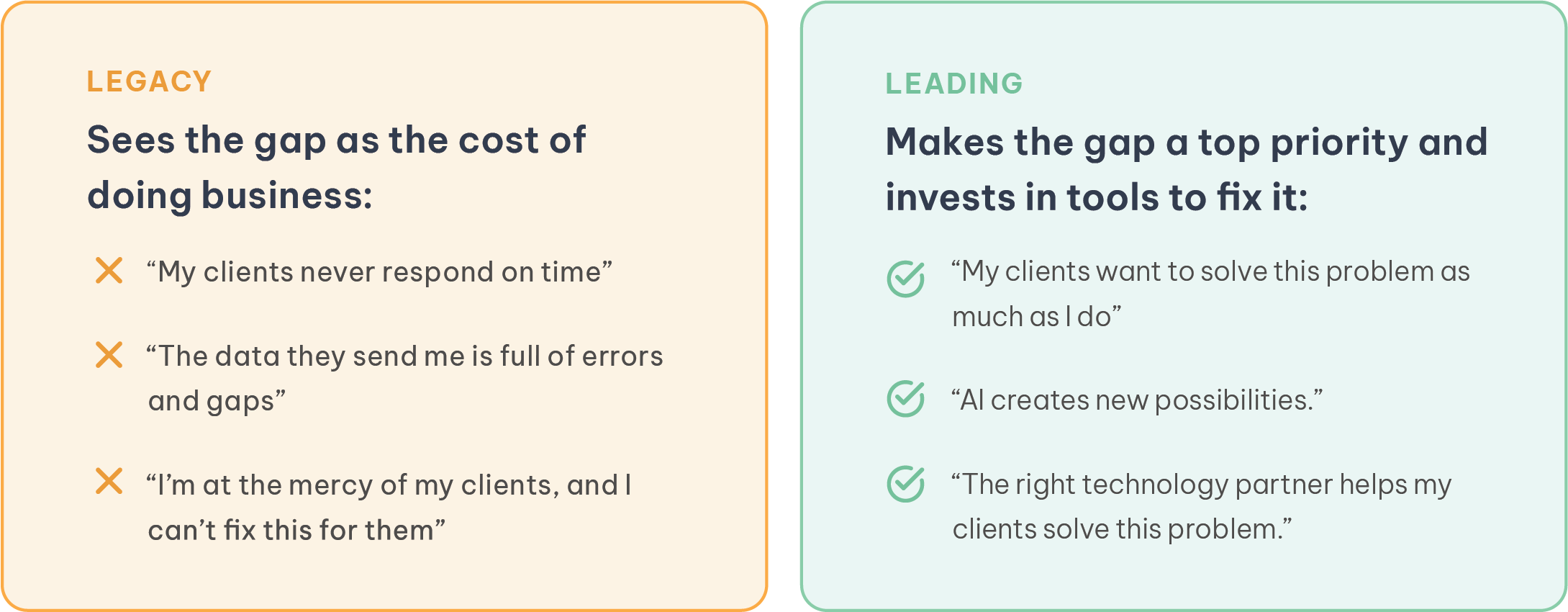
As years and decades passed, many accounting professionals have learned to live with the Client Readiness Gap. Because they can’t control their clients or do the work for them, they see it as an intractable problem that is outside of their control. They see it as the cost of doing business. This legacy mindset prevents them from seeing what is now possible.
Leading firms have a different mindset. They see addressing the Client Readiness Gap as one of their top priorities. And they invest in the tools that can help them, and their clients, fix it.
For years, Suralink’s market-leading platform has provided purpose-built capabilities that help close the Client Readiness Gap. And now AI has created even greater possibilities to address this bottleneck. And the positive impact on firms is clear.
Closing the Client Readiness Gap with Suralink and Document Prescreen Agent
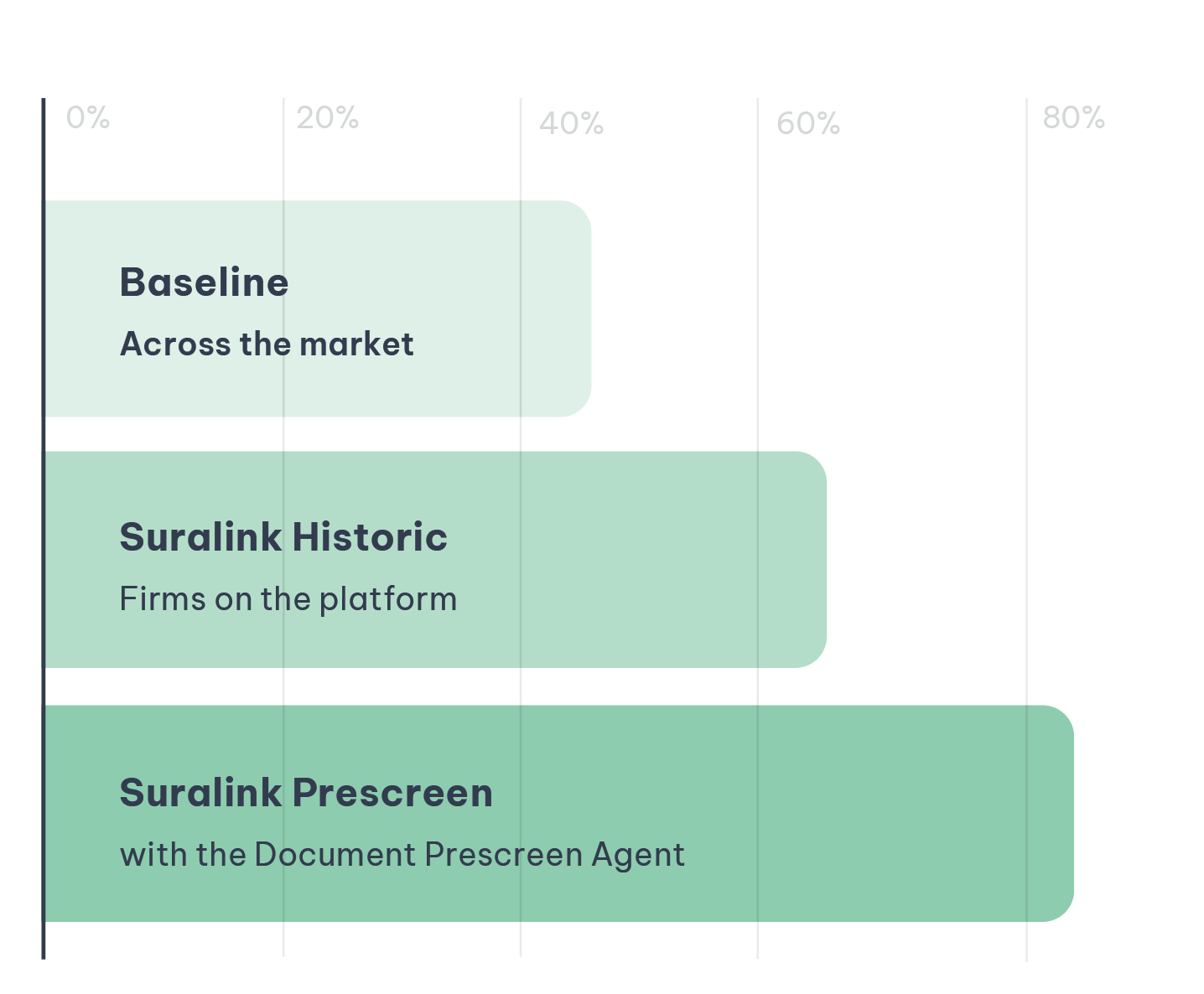
Recall that across the market as a whole, firms report that only 45% of client responses are correct and complete the first time[4]. For Suralink firms, this figure rises to 65%[5]. That is a significant >40% increase in the frequency of correct and complete client responses, and that is a dramatic decline in the amount of rework firm teams need to do.
Suralink customers have benefited from this higher “correct and complete” response rate for years, and it is one of the reasons that Suralink firms have outgrown their peers each of the last 5 years (see our latest firm growth report). It’s also why Suralink has the highest user satisfaction of all comparable platforms.
But now these results are going to get even better!
Correct and complete on the first try:
Suralink’s recently released Client Document Prescreen Agent automatically checks each client upload in real-time.
If an error or gap is found, the agent provides immediate feedback to the client, enabling them to quickly fix the gap or to provide an explanation. The agent is able to screen for all five common error types covered earlier.
All of this happens without a firm team member having to waste time reviewing incorrect or incomplete client data. This dramatically cuts down on the amount of rework and wasted effort a firm has to incur on an engagement, improving margins, freeing up capacity, and eliminating one of the largest sources of team frustration.
So far, Suralink’s Prescreen Agents have been shown to increase correct and complete response rates to over 80%[6]. That is ~2x the baseline response rate.
Firm users universally agree about the value of a Prescreen Agent. 98% say that they would find this type of agent very helpful, and estimate that it will save them and their team members 20+ hours per engagement[7].
20+ hours saved per engagement is an enormous amount of value. But the value of Suralink’s Prescreen Agents isn’t just measured in time saved. It’s also measured in improved client satisfaction, fewer last minute scrambles, and higher employee retention.
1. Suralink CPA Market Study, global respondents across North America, Europe, and APAC, administered by a third-party research firm. Regional figures are averaged equally across the three regions.
2. Same study; audit engagements.
3. Same study; top-three struggle question.
4. Same study; share of client requests fulfilled correctly the first time.
5. Proprietary Suralink platform data. The 16-day figure is an average of firm review time. Error reasons come from agent-returned requests.
6. Based on initial firm feedback.
7. Base: 124 respondents in Europe and APAC.