

Executive Summary
Many accounting firms today remain focused on increasing operational efficiency and improving realization rates. Yet, many lack visibility into the root causes of the friction that consistently disrupt engagements, resulting in timeline delays, budget overruns, and unmet client expectations. Without a clear line of sight into these operational blind spots, firms risk undermining both performance and retention in the near and long term.
This report builds on The State of Audit Efficiency study by gathering insights from a broad audience of accounting firm clients—notably, not limited to or even targeting Suralink’s client base—to ensure its findings represent the industry as a whole. It explores the clients’ perspectives on the most prominent pain points throughout the engagement process. Drawing from both firm and client experiences across audit, tax, and advisory services, these reports identify a critical problem: misaligned expectations, poor communication, and fragmented workflows between firms and their clients, a phenomenon we call the Client Readiness Gap.
This gap leads to delays and inefficiencies in fulfilling firm requests, causes engagement slowdowns, increases friction between engagement teams and their clients, and ultimately, contributes to growing client dissatisfaction.

The Suralink Advantage
Suralink is more than just a portal; it's the agentic automation platform built for best-in-class collaboration across the entire Request-to-Review process. Investing in the client collaboration experience is the #1 way firms can address the Client Readiness Gap, and ensure engagements run efficiently and effectively across every service line—from audit and tax to advisory.
It's also the #1 way to increase client satisfaction and loyalty. Clients have independently rated Suralink as their favorite collaboration tool to use.
| Platform | % "Satisfied" or "Very Satisfied" | Suralink % Better |
| Suralink | 66% | - |
| Sharefile | 46% | 43% |
| 27% | 144% | |
| CCH Axcess | 20% | 230% |
| AuditDashboard | 13% | 408% |
| Dropbox | 48% | 38% |
| Google Drive | 50% | 32% |
| Other/in-house built tools | 47% | 40% |
| Average of non-Suralink platforms | 36% | 83% |
*Audience surveyed was not limited to Suralink’s customer base to provide an accurate representation of the accounting industry and the viewpoint of their clients.
**Note that Inflo, Thomson Reuters, Caseware, Hubsync, Taxcaddy, Uplink, Smartsheet, Validis, and Circit were excluded in the above table because they had <5 responses and were not statistically relevant. Overall, the combined satisfaction rating for those 9 providers was only 47%.
Key findings
Background, information, and demographics
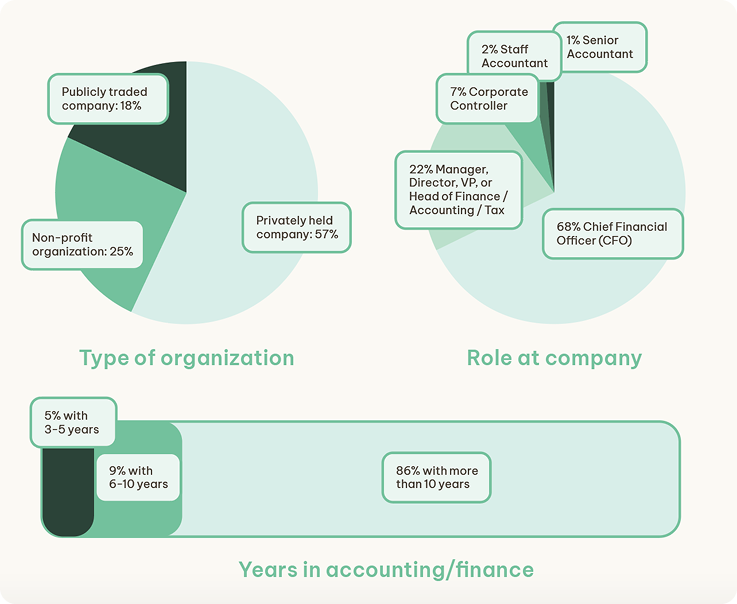
The survey targeted full-time finance and accounting professionals in North America with at least three years of experience in their field across non-profit, private, and publicly traded organizations of all sizes. The data below offers further insight into the profile of those who participated in the study. To accurately capture the current state of the industry, the survey was not limited to Suralink’s customer base to provide a true industry-wide perspective from the viewpoint of today’s accounting firm clients.
Findings
*The survey data below represents the overall accounting industry, and is not specific to Suralink firm and client users.
Understand the Client Readiness Gap
Where the client-firm disconnect begins, and where it feeds the Rework Cycle
Despite ongoing efforts to enhance operational efficiency and improve realization rates, friction across engagements continues to build. While staffing shortages and resource constraints remain real challenges, they are not the primary drivers of the strain firms are experiencing at scale. Nor are these issues limited to a few isolated cracks in the process.
At the center of it all is the Client Readiness Gap: the misalignment in expectations, processes, and priorities between firms and their clients at the onset and throughout the engagement experience. It's one of the three structural causes behind the Rework Cycle, the #1 driver of engagement inefficiency. This disconnect leads to delays, miscommunication, and slow document turnaround. Although commonly perceived as client-side inefficiencies that hinder progress, the data show that both firms and clients contribute to the widening gap and the downstream effects of missed deadlines, rising costs, and growing dissatisfaction.

Client priorities and expectations
What clients actually want from accounting firms and why many aren’t getting it
As firms continue to deliver on the technical aspects of the engagement, clients are increasingly evaluating engagements through a more comprehensive rubric, one that goes beyond checking the “completed” box to include other key experience factors such as clarity, efficiency, and ease of collaboration.
Clients come to the table with clear priorities, primarily for oversight, compliance, and external validation. Less direct, but implied, are the expectations they have for the engagement to run smoothly while minimizing the time burden on their teams. Yet, far too often, engagements fall short in meeting the latter needs, undermining the perceived value of the entire experience, regardless of whether or not core priorities were met.
Where clients see the real value
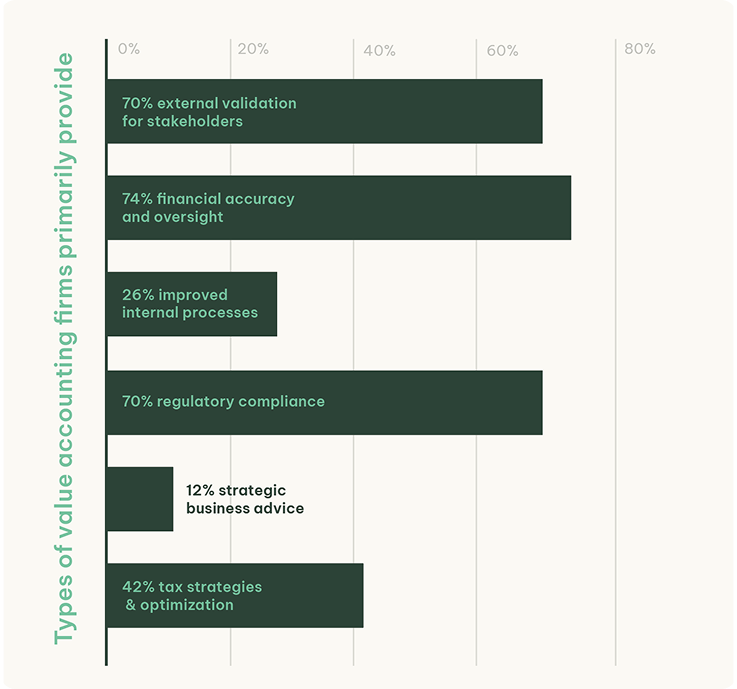
Most clients engage accounting firms out of necessity. It’s often a requirement initiated by regulatory obligations, audit requirements, or the need to deliver externally validated financial statements or other key reports to stakeholders.
Behind the need to meet obligations and mitigate risk lies a set of well-defined expectations:
-
Financial accuracy and oversight (74%)
- Regulatory compliance (70%)
- Regulatory compliance (70%)
Together, these findings reflect a clear expectation for firms to serve as stewards of financial integrity, responsible for both execution and for reinforcing the organization’s credibility and risk posture.
Where client satisfaction is won and lost
Once an engagement begins, clients start evaluating the firm not just on what they know but also on how they work. And here, the stakes are high. If engagements feel cumbersome or communication breaks down, trust and perceived value quickly erode.
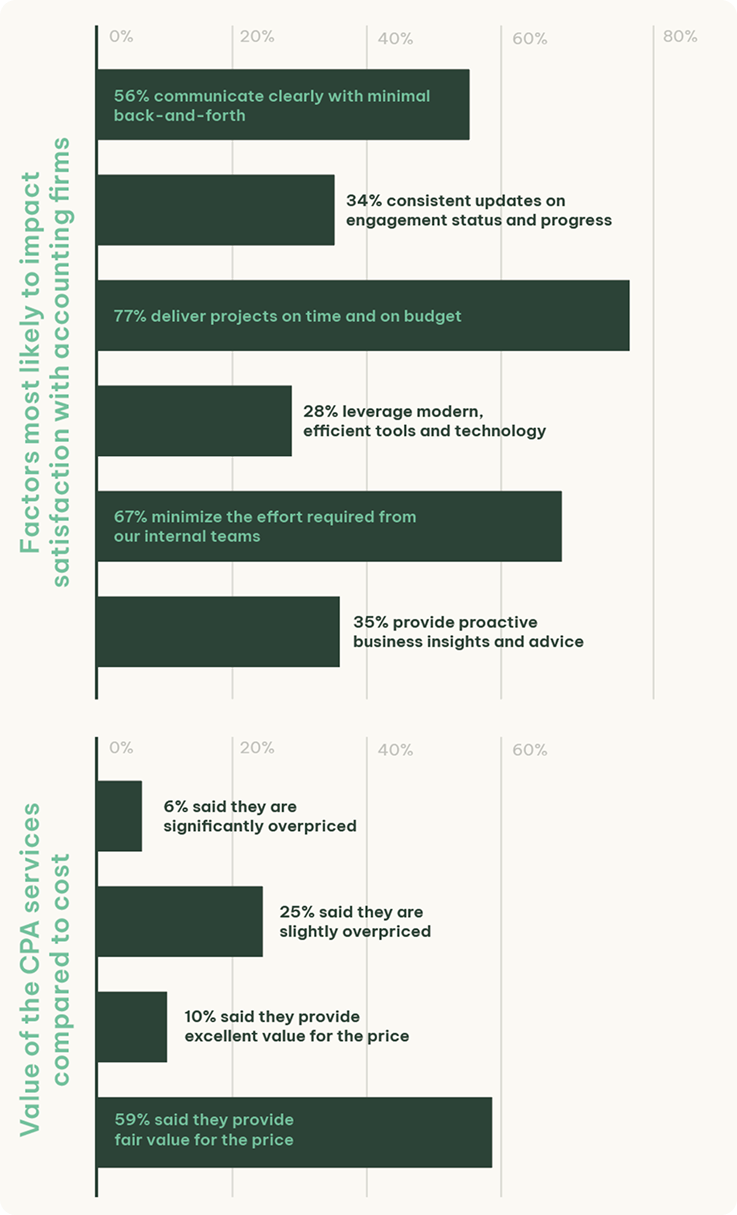
For today’s clients, on-time, on-budget delivery is the baseline, with 77% citing it as one of the most important drivers of satisfaction. Another 67% want firms to reduce the effort required of their internal teams, and 56% say that clear, low-friction communication is key. Clients expect accounting firms to show up as operational partners who streamline the process and carry the bulk of the engagement weight.
Even when firms meet deadlines and complete engagements, many clients still ask a lingering question: Was it worth it?
Only 10% of clients say the value of the services they receive is “excellent” compared to the cost. Nearly 60% believe the price represents fair value, while 31% say services are “slightly overpriced” or “significantly overpriced.”
This disconnect between cost and overall experience is worth noting. If a firm delivers on paper but drains the client’s time, creates friction, or fails to communicate clearly, the perceived value collapses. Clients now expect technical competence, and exceptional collaboration is essential to establishing and securing an ongoing relationship.
*The survey data above represents the overall accounting industry, and is not specific to Suralink firm and client users.
Clients’ experience and reality
Why the Rework Cycle persists and what's really behind it
Despite engagement outcomes, firms still struggle to deliver seamless client engagements. Beneath the surface of project timelines and compliance checklists lies a constant source of friction. The daily realities clients face in managing their side of the engagement shape the total experience. These often-unseen burdens directly influence perceptions of value, responsiveness, and satisfaction.
A disconnect between firm expectations and client experience, one that contributes directly to the Client Readiness Gap, continues to widen. Clients are signaling that the greatest sources of engagement friction stem not from technical complexity, but from lack of clarity, insufficient collaboration, and overlooked capacity constraints. The following four sections illustrate where the tension arises and where firms should direct their attention.

Where clients experience the most pressure during engagements
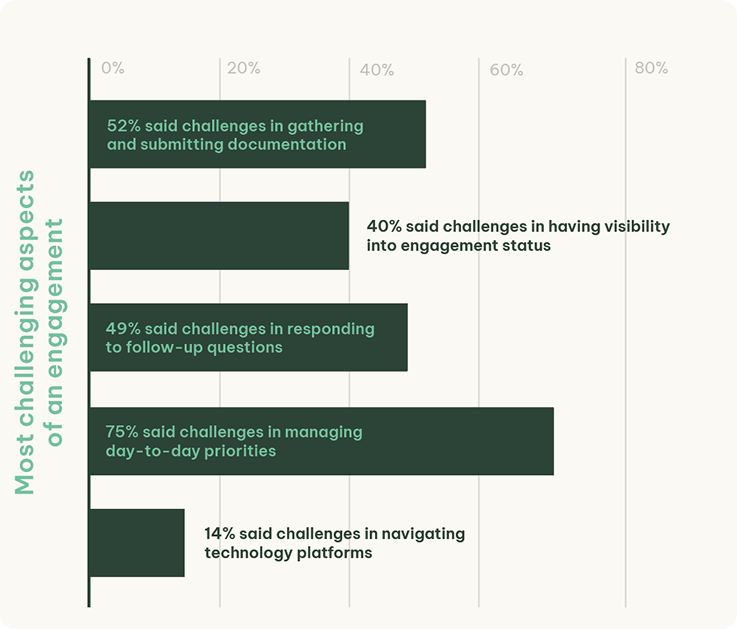
Engagements often require clients to juggle two roles, one supporting their accounting firm and the other fulfilling their core responsibilities. The top engagement challenge, cited by 75% of clients, is balancing core responsibilities with the demands of the engagement itself.
Nearly half of clients report that gathering firm-requested documentation (52%) and responding to follow-up questions (49%) create additional strain. These tasks add a layer of operational drag that slows progress and fuels frustration. When firms underestimate the complexity of a client's internal operations, even small requests can create significant disruption.
 What frustrates clients the most
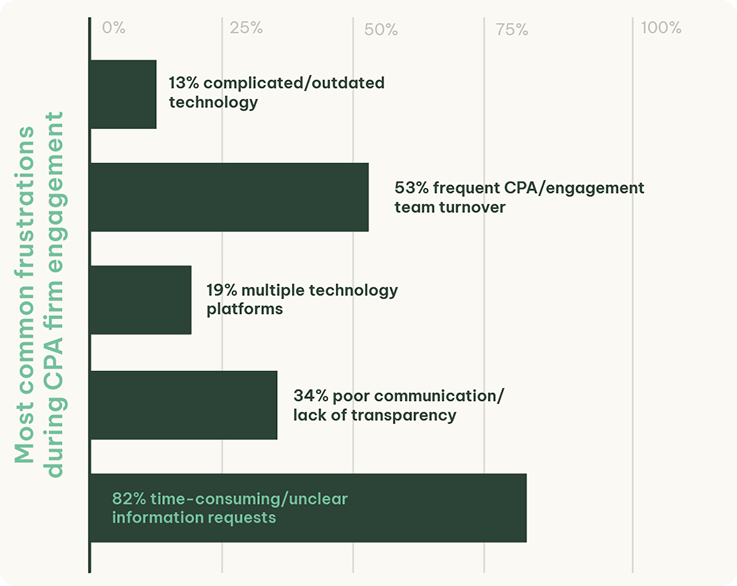
The mechanics of engagement execution are often a primary source of client dissatisfaction. The most frequently cited frustration is unclear or time-consuming information requests, reported by 82% of clients. While this highlights the frustration caused by poor communication, it’s also reflective of the lack of structure, consistency, and context provided during requests.
When clients face shifting points of contact or operate without clarity on where things stand, the engagement breaks down.
What clients say would improve engagement efficiency
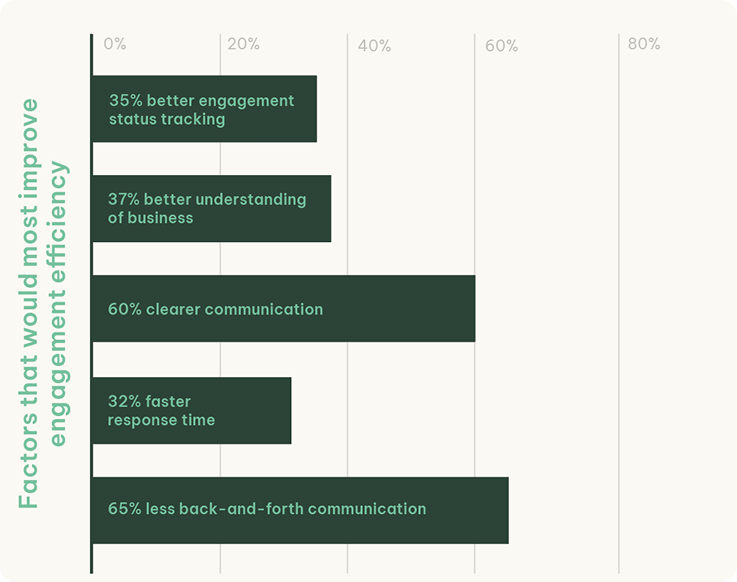
Improving engagement efficiency doesn’t require a total transformation. It requires eliminating friction where it matters most. A majority, 65%, of clients say reducing back-and-forth would have the greatest impact, and 60% point to clearer communication as the most meaningful improvement.
These findings show that clients are not frustrated by the work itself, but rather by poor communication. When firm requests are vague and timelines are unclear, it increases the likelihood of rework and delays.
What clients want their firms to understand
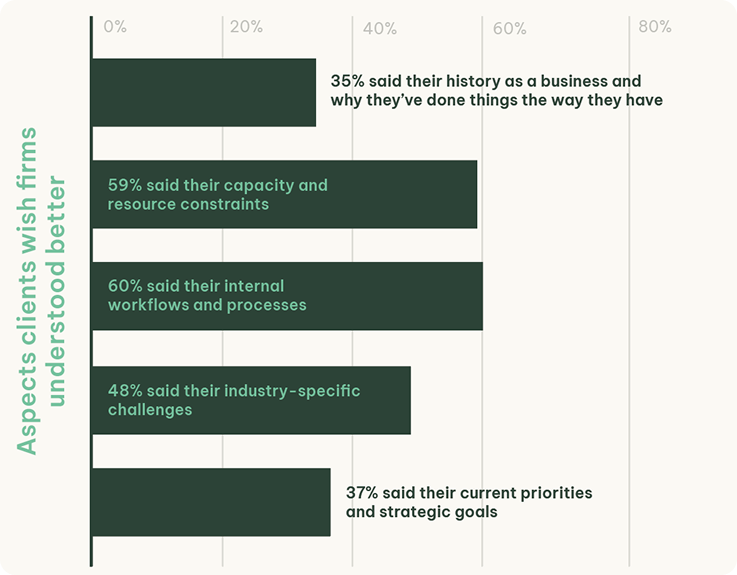
Clients are limited by realities that firms often, and for several reasons, fail to see. According to clients, 60% say they wish their firm better understood their internal workflows and processes, and 59% want firms to understand their capacity and resource constraints.
This insight highlights a broader need for firm empathy and operational alignment, a desire for a more human connection during the engagement process.
The truth behind the biggest gaps and what they cost
This study found that the greatest source of strain in client engagements stems from one fundamental issue: poor communication.
Whether it's an unclear request from the firm or inconsistent communication channels, poor communication continues to be the leading driver of the Rework Cycle, the cycle of re-work that drains engagement efficiency and firm capacity.
Frequency & causes of miscommunication
Lack of clear communication remains one of the most consistent contributors to the Client Readiness Gap, affecting everything from timelines to workload.
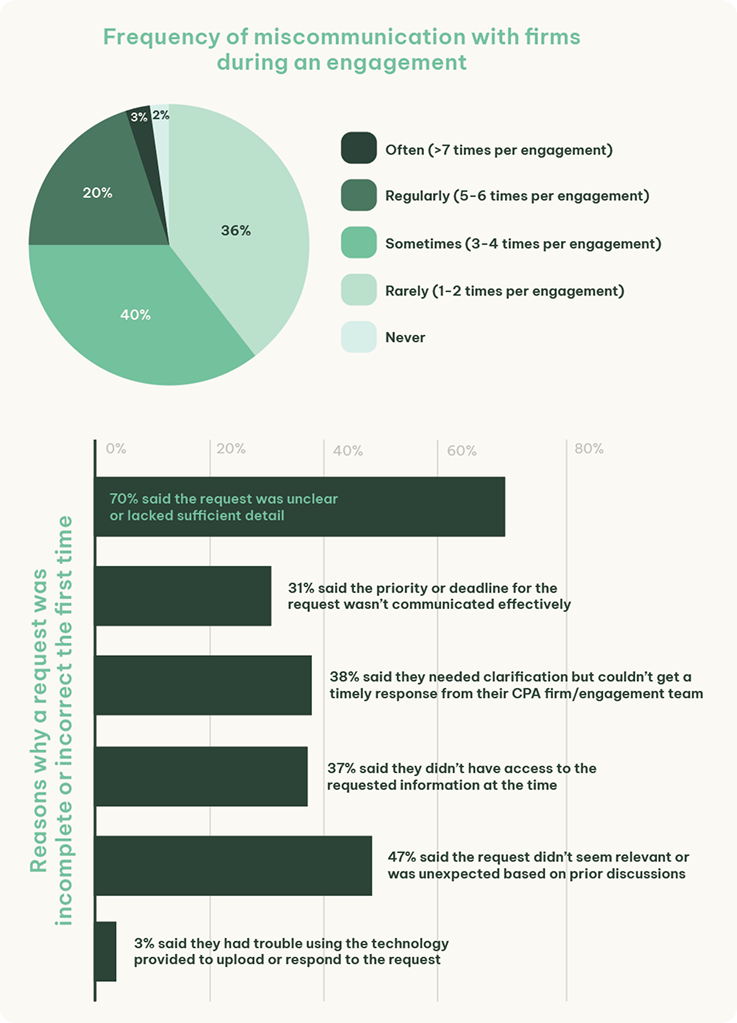
Clients report high levels of miscommunication or expectation misalignment, with 62% experiencing five or more per engagement. This is a signal of a systemic issue in direction, priorities, or deliverables that add unnecessary friction to already demanding engagements.
These misalignments also create an additional drag on clients' time, with clients reporting an average 14.4% increase in time required to complete an engagement. At the same time, they experience an average 12.3% decrease in time available for their core job responsibilities. This means engagement inefficiencies are both inconvenient and have a tangible impact on clients' day-to-day operations.
When clients fail to fulfill requests the first time, the reason is rarely due to negligence:
-
70% say the request was unclear or lacked sufficient detail
- 47% say the request felt irrelevant or misaligned with prior discussions
- 38% say they needed clarification but were unable to receive timely support from their engagement team
The truth behind the biggest gaps and what they cost
The Request-to-Review experience has become the center of the client relationship. It combines request management and document exchange, and 70% of clients say it's where they spend the most time during an engagement.
Additionally, clients are clear on what they need within these solutions:
-
70% say the request was unclear or lacked sufficient detail
- 47% say the request felt irrelevant or misaligned with prior discussions
- 38% say they needed clarification but were unable to receive timely support from their engagement team
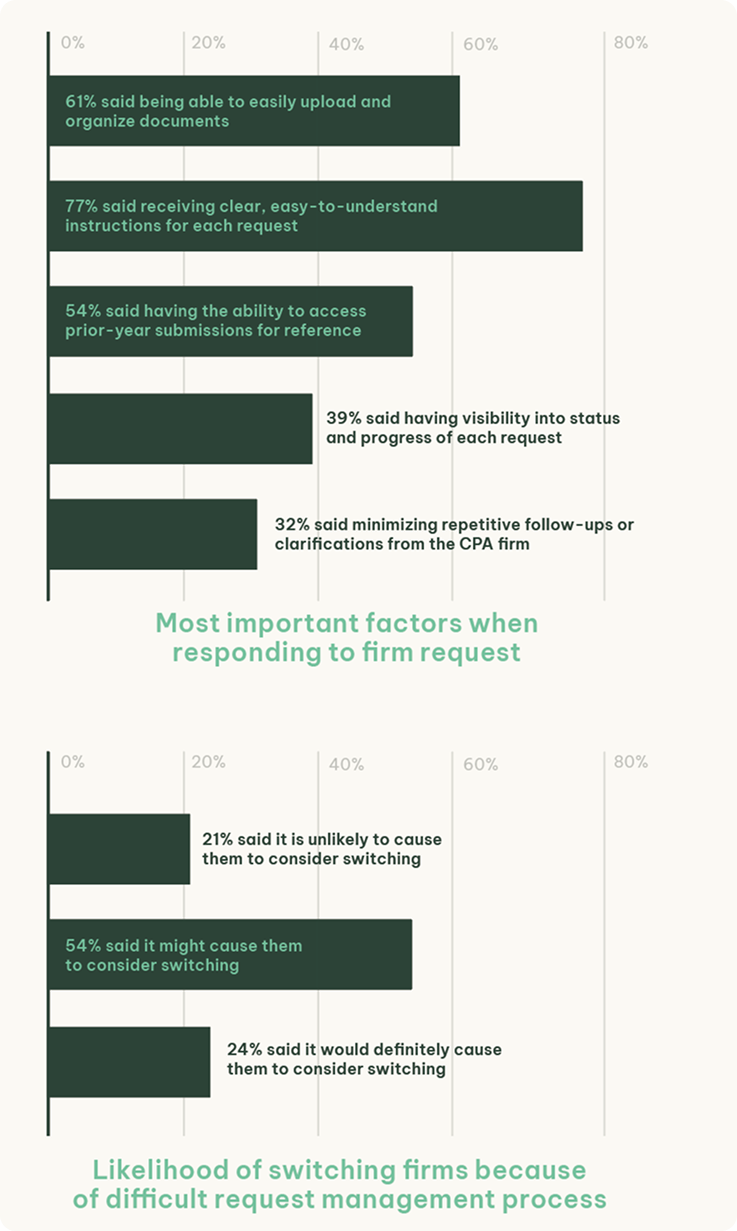
Clients need a unified Request-to-Review platform when engagement teams work with them. Furthermore, more than 50% of clients say they find it frustrating when firms use both email and portal-based systems, and prefer centralized requests to simplify tracking.
The consequences of poorly organized systems are severe, with nearly 8 out of 10 clients noting they'd consider switching firms over a poor technology experience, highlighting the importance of an intuitive client tech stack to achieve both operational efficiency and long-term client retention.
What firms can do to close the Client Readiness Gap
The Client Readiness Gap isn’t caused by a single, unmet expectation or process misalignment. It’s the product of small breakdowns that compound over time. It often begins as one unclear request or delayed response that ripples throughout the engagement, and eventually, through a firm’s entire book of business.
Closing the gaps that pose the greatest risks to the client experience requires a rethinking of how firms operate. Firms must re-evaluate how they can provide clear and proactive communication, technology that simplifies the client’s role, and a process that respects the client’s workload. These adjustments can’t be superficial. They must represent a shift in how firms engage, support, and collaborate with their clients.
The following insights offer tactical and strategic guidance for how firms can begin to close the gap.

Number 1: Make every request clear, consistent, and easy to act on
Clients don't struggle with the technical aspects of completing their engagement workload. What slows them down is vague instructions, inconsistent requests, and delayed clarification.
This is where firms have the greatest opportunity to close the Client Readiness Gap.
-
70% of clients say they fail to complete requests correctly the first time due to unclear or incomplete instructions
- 47% say requests often conflict with prior conversations
- 38% report they can't get clarification in a timely manner
- 62% experience communication or expectation misalignments more than five times per engagement
How firms can address this:
-
Clarify expectations at the start of every engagement — Define client needs, priorities, workflows, and known constraints
- Standardize how engagement requests are made — Use consistent processes across teams to reduce confusion and set clear expectations
- Consolidate tools to keep everything in one place — Centralize communication and documentation in a single Request-to-Review platform to streamline the client experience
- Set deadlines and automate reminders — Communicate timelines early and use system-generated nudges to keep both teams aligned and on track
- Respond quickly when clients need clarification — Commit to answering client inquiries within 24 hours

Number 2: Replace fragmented solutions with technology that works for clients
Clients spend most of their engagement time in the firm's request management portal, and many say the experience is disjointed and inefficient. Despite being the most frequently used touchpoint of the engagement, it's often under-resourced or inconsistently used.
-
70% of clients spend the majority of an engagement in a document portal
- 51% find it frustrating when requests are split between email and the request portal
- 54% want access to prior-year submissions
Clients also report an openness to using newer technologies, especially if the tools can reduce the burden of the engagement:
-
94% of clients are at least "somewhat" comfortable with AI in engagements
- 91% express interest in an AI-powered tool that can automatically review and confirm documents
How firms can address this:
-
Commit to an intuitive, centralized request portal — Eliminate email-based workflows and bring all requests, documents, and communication into one unified Request-to-Review platform
- Enforce consistent use of the portal across teams — Set internal standards to ensure every engagement request runs through the same system to avoid confusion and provide transparency
- Make historical records easily accessible — Give clients direct access to prior-year submissions so they can quickly reference past materials
- Introduce automation to reduce manual effort — Use AI agents, like Suralink's Document Prescreen Agent, to automatically review uploaded documents for completeness and formatting before they reach the engagement team

Number 3: Design an engagement process around client capacity, not just firm efficiency
Clients manage engagements alongside their full-time job responsibilities. For many, supporting a firm feels like taking on a second job. When firms overlook this, the relationship becomes strained.
-
75% of clients say managing day-to-day priorities during an engagement is one of their biggest challenges
- 60% want firms to understand their internal workflows better
- 59% want recognition of their limited capacity and resources
How firms can address this:
-
Ask about internal workflows and constraints at kickoff — Understand how clients manage requests internally, who's involved, and what bottlenecks might arise during the engagement
- Build flexibility into your process and timelines — Allow for realistic turnaround times that reflect the client's existing workload and internal dependencies
- Minimize the number of requests and follow-ups — Batch requests where possible and avoid unnecessary check-ins that disrupt the client's day
- Acknowledge that engagements are an added load to client teams — Position your firm as a partner by showing empathy and proactive planning throughout the process
- Use data to adapt your approach — Track where client delays or friction occur and adjust workflows to prevent those issues in future engagements
- Train your team to recognize capacity signals — Equip staff to spot signs of client bandwidth strain and know when to slow down, offer flexibility, or escalate support
The bridge forward
For years, the Client Readiness Gap has been a very real yet unnamed threat to firms. Its effects have been widely felt across every stage of the engagement process, and often accepted as the cost of doing business. However, firms that identify and understand the nuanced misalignments of the Client Readiness Gap within their practice that negatively impact the client experience will have an early opportunity to reinvent themselves. They will be poised to improve profitability by moving from transactional services to strategic partnerships.
Inside the Client Experience serves as a snapshot of today's unmet expectations, emerging client preferences, and long-standing inefficiencies that continue to strain engagement experience and relationships.
Whether the gap narrows or widens from here will depend on the actions firms take and their willingness to evolve alongside their clients.
Across all lines of service, clients are asking firms to take concrete action to improve the engagement experience. They want firms to communicate more clearly and consistently, to deploy modern tools that reduce the back-and-forth, and to operate with greater empathy for the demands they face. Overall, they want firms to align with how they work today.
The Client Readiness Gap is a shared challenge, but the responsibility to close it starts with the firm. Real progress will come from firms that treat these gaps not as isolated pain points but as opportunities to lead and set a new operational standard.
Product overview
Suralink is the agentic automation platform for accounting firms and their clients. We help firms deliver their most efficient engagements ever by unifying the entire Request-to-Review process. From PBC and testing to workpaper prep, tie-out, and review, we give teams AI agents that pre-screen data, automate audit procedures, and surface critical insights. With enterprise-grade security, an intuitive interface, and powerful workpaper automation capabilities—including seamless Excel integration—Suralink enables efficiency, accelerates engagement workflows, and strengthens client relationships.
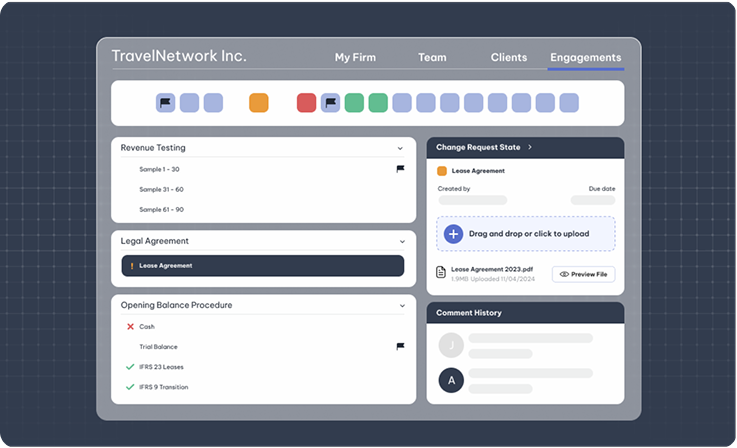
Request List Management
Request, organize, and track PBC documents in real time
-
Team accountability: Assign team members to specific clients and requests to ensure clear ownership.
- Real-time insights: Track request statuses in real time with interactive dashboards that help optimize workflows.
- Automated notifications: Keep clients and teams on schedule with real-time updates and deadline reminders.
- E-signature: Streamline electronic signoffs with a user-friendly drag-and-drop interface, robust audit trail tracking, and enhanced security through knowledge-based authentication (KBA).
Suralink Agent Library
AI agents that pre-screen data, automate audit procedures, and surface critical insights before problems become blockers for your team. Includes the Document Prescreen Agent, Data Vouching & Multi-Level Vouching Agents, and Tie-Out Agents.
Workpaper Suite
Streamline workpaper preparation, review, and collaboration
-
Excel-native add-in: Complete work directly inside Excel with tools built for accounting workflows—no new system to learn.
- Connected workflows: Link client requests, support docs, and workpapers to streamline prep, review, and finalization.
- Automated notifications: Keep clients and teams on schedule with real-time updates and deadline reminders.
- Faster prep and review: Eliminate version confusion and duplicate tasks with real-time file status and centralized comments.
- Built-in collaboration: Communicate across engagement teams and clients without switching tools or losing context.
Secure File Sharing
Send and request one-off files of any size using unique, secure links
-
Effortless uploads: Share files seamlessly using drag-and-drop functionality with unlimited cloud storage.
- Integrated convenience: Send and receive large files directly via Microsoft Outlook using the built-in add-in.
- Data protection: Generate secure document links as needed to maintain confidentiality.
Client Data Vault (CDV)
Gives clients their own permanent, complete workspace instead of the back-and-forth of email.